

Structural Aspects of Magmatic Rocks: Comparison between outcrop and seismic data interpretation in the Western Iberian Margin (portugal)
Relevance for hydrocarbons and natural hydrogen exploration and implications on CCUS.
(On-demand field-based training course)
Introduction
This 5 day professional training course takes place along the Western Iberian Margin (WIM), between Alentejo Basin (including CAMP and Sines Igneous Complex) and the Lusitanian Basin (including Sintra Igneous Complex and Lisbon Volcanic Complex), in Portugal.
The main objective of the field trip is to highlight the complexity and problematics of interpreting magmatic-related structures on different datasets and at different scales (outcrops, seismic data, potential fields data), while understanding the implications of magmatism in the regional and local structural framework, hydrocarbon maturation, reservoir properties distribution, trap creation and/or destruction, natural hydrogen generation and CO2 sequestration and mineralization.
The West Iberian Margin (WIM) recorded three major magmatic events during Mesozoic. The first is related with the Central Atlantic Magmatic Province (CAMP) between c. 200-198 Ma (Hettangian) at the end of the first rifting stage, the second, late Jurassic to early Cretaceous (148-140 Ma) in age, is concomitant with the last rifting phase recorded and the third is the most pronounce and widespread along the margin that occurred in a post-rift context during Late Cretaceous (94-69 Ma).
These magmatic events left excellent exposures along coastal and inland areas, both of intrusive and extrusive nature. Recent 3D seismic acquisition campaigns, together with high-resolution gravity and magnetic data allowed further identification and characterisation of offshore magmatic structures related with these events.
As a consequence, the West Iberian Margin can be used as a natural laboratory to compare between outcrop and seismic data allowing the interpretation of the structural styles associated to magmatism at different scales and comparison with other similar magmatic provinces around the world.

Upper Cretaceous trachybasaltic sill at Lombas dos Pianos
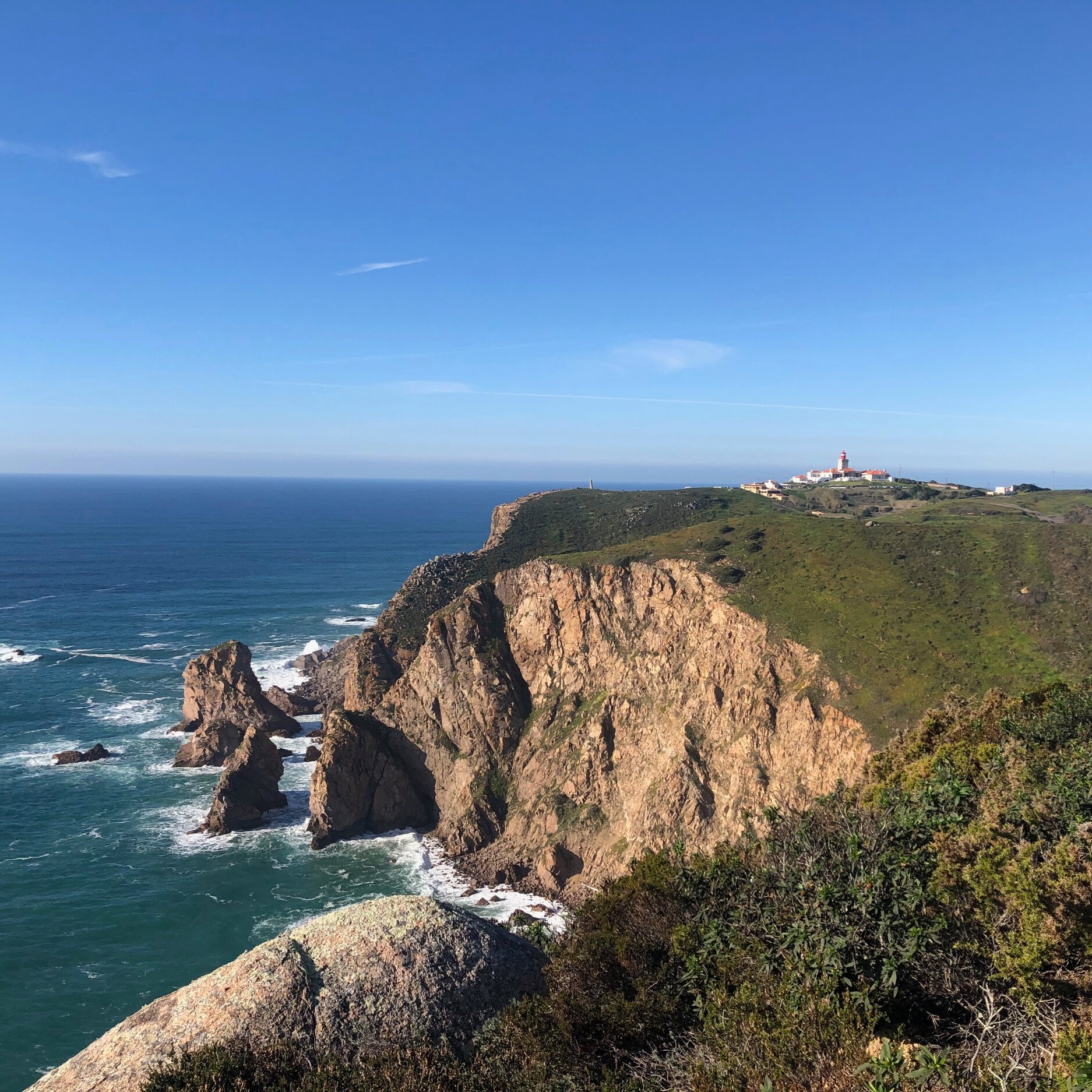
Sintra Igneous Complex syenites at Cabo da Roca
Course Characteristics
Physical requirements: Easy to moderate. Some field localities may require walking approximately 2 km on easy to moderate terrain. Short walks (approx. 100m) over large boulders along the beach may be required.
Duration: 5 days
Type: Field-based training course and evening talks
Area: Southwest and Central Costal Portugal
Target audience: Geology students, geologists, field geologists, oil and gas professionals, CCUS professionals, structural geologists, reservoir geologist and engineers, geology engineers, geophysicists.
Pre-requisites: Basic structural geology and basic igneous petrology.
What’s included: Transportation, meals, accommodation in 4 star hotels, digital and paper field guide, personal insurance, IPE (Hardcap, reflective vest and walking poles).
Number of participants: Minimum of 8 and maximum 15 persons.
Course Cost: 3800 € (excl. tax). Early bird discount available (10%) for the first 5 participants until February 2025.
Instructors
Pedro Barreto: Founder of Geo Logica, graduated in Geology from University of Lisbon and MSc in Tectonics from Royal Holloway, University of London. Former Senior Structural Geologist at CGG - NPA Satellite Mapping, developed geological mapping for oil, gas and mining exploration in Europe, Africa, Middle East, South America and Asia. Former Senior New Ventures and Exploration Geologist at Partex O&G, was Lead Project Geologist for Portugal and Africa exploration. Co-authored several publications and presentations on rifting and salt-tectonics, and implications on exploration, development and exploitation of natural resources for energy production and storage.
Tiago Cunha: Degree in Geology from Lisbon University (PT) and PhD in Marine Geophysics from Oxford University (UK). 15+ years’ experience in basin and petroleum systems modelling in sedimentary basins around the world combining a wide range of observational and modelling techniques, integrating geological, geophysical and geochemical data. 10+ ISI publications and numerous presentations at international meetings. Currently working at I.G.I Ltd, focused in the tectonic and thermal evolution of sedimentary basins and its implications for the petroleum systems. Promoting and developing novelty research and applications for the natural hydrogen and CCS industries.
Marianne Nuzzo: Graduated in Geology from the University of Toulouse (France), obtained her MSc in Hydrogeology and Environment from the University of Avignon (France), after which worked for a couple of years as a hydro-geochemist. PhD in hydrocarbon seep geochemistry at the University of Bristol (UK), followed by seven years of research in marine seep geochemistry at GEOMAR, Helmholtz Institute for Ocean Research (Germany) and at the Marine Geology Department of the Portuguese Geological Survey (now IPMA). Joined I.G.I. Ltd in 2014, where works as senior organic geochemist and is developing Net-Zero consultancy expertise.
Ricardo Pereira: Assistant Researcher at GeoBioTec (Univ. Nova Lisboa) and Researcher/External collaborator at Instituto Dom Luiz (Univ. Lisboa). Graduated in Geology from Lisbon University, MSc in Stratigraphy and Sedimentology at Lisbon University and PhD from Cardiff University, developing research on the evolution of passive continental margins, salt tectonics and subsurface energy storage. With over 22 years experience in the O&G industry, Ricardo has worked as regional exploration geologist for PARTEX Oil and Gas, and Petroleum Development Oman, contributing to world class discoveries in major salt provinces, including the discovery of pre-salt Santos Basin, the Oman salt provinces and offshore Angola.
Main Topics
Regional context of WIM;
Types of magmatic rocks
Structural styles associated with magmatic rocks (intrusive and extrusive);
Metasomatism and contact metamorphism;
Magmatics rocks on seismic datasets vs outcrops
The structure of host rocks;
CAMP, syn-rift and post-rift magmatism;
Source rock maturation associated with magmatic rocks;
Reservoir properties variations associated with magmatic rocks;
Traps and seals creation/destruction associated with magmatism;
Carbonation of magmatic rocks and CCUS;
Magmatic rocks as potential reservoirs and seals for CCUS;
Natural Hydrogen generation associated with magmatic rocks;

Zeolite-filled decompression fracture network at Lomba dos Pianos trachybasaltic sill.

Metassomatic alteration and pinch and swell structures adjacent to Sintra Igneous complex at Ponta da Abelheira.

Detail of prismatic joints at Penedo do Lexim volcanic plug, part of the Lisbon Volcanic complex.
Program
Day 1
-
Departure from Lisbon Airport (8:30 am)
Santiago do Cacém CAMP outcrops
Lunch at Santiago do Cacém
Sines Igneous Complex Oucrops
Dinner at Sines
Hotel in Sines
-
On the first day of the field course the structural framework of the Western Iberian Margin (WIM) will be explained while observing the sedimentary and igneous record that characterises the initial infill of the Mesozoic basins along this margin.
At Santiago do Cacém, participants will observe Late Triassic to Lower Jurassic units interbedded and cut by 200 Ma Central Atlantic Magmatic Province (CAMP) rocks. Here, the group will observe lava flows deposited unconformably over Hettangian dolomites and evaporites with associated copper mineralisations.
At Sines, participants will observe the main lithologies and structures that constitute the Sines Igneous Complex, as well as metamorphism and deformation of the host rock while understanding its implications on reservoir property changes for carbon storage and hydrocarbon accumulations.

Disconformity between Hettangian dolomites and CAMP lava flows at Santiago do Cacém.
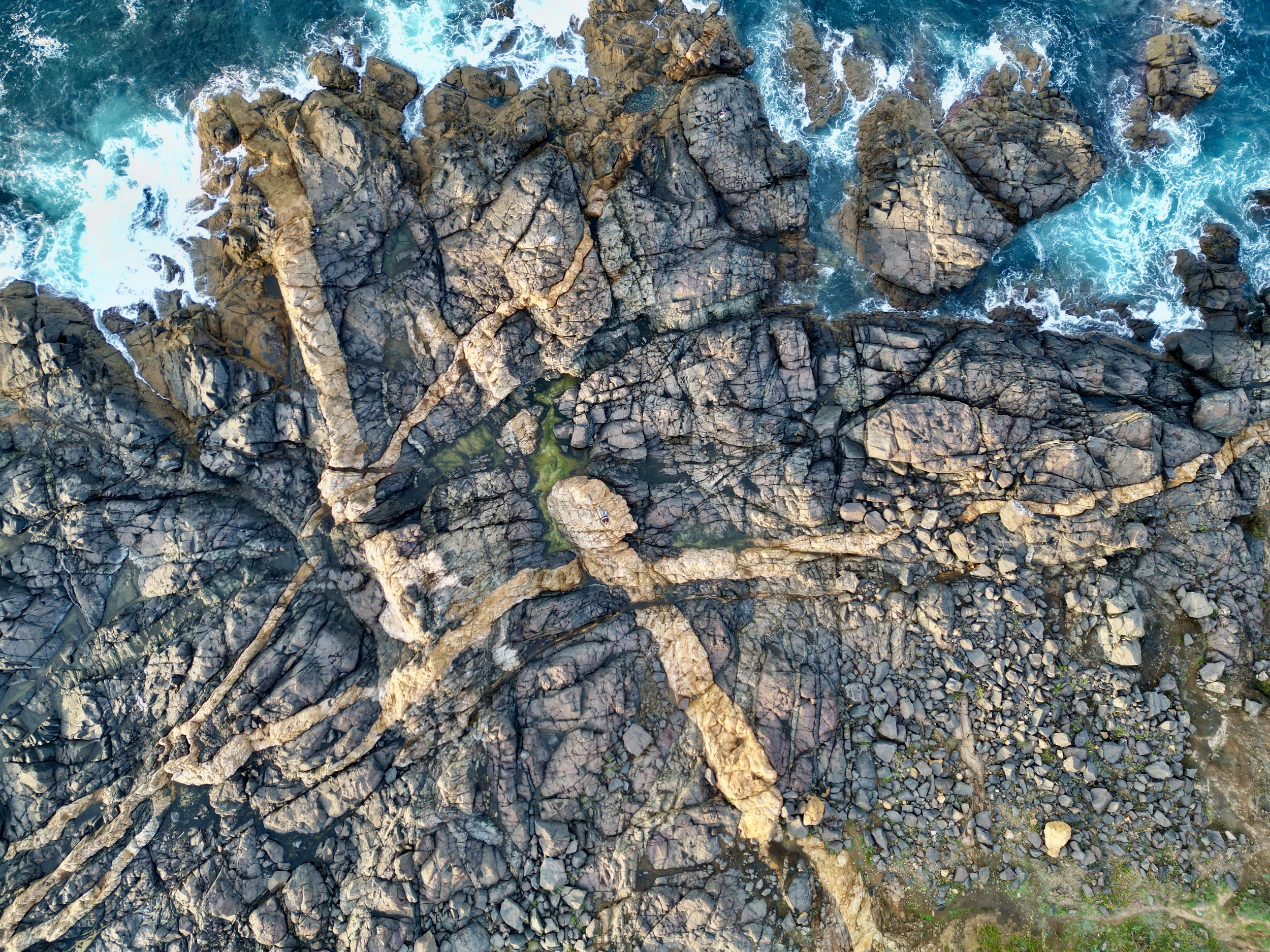
Late Cretaceous Sines Igneous Complex grabbro-diorites intruded by syenites, trachytes and microgabbros at Sines.
Day 2
-
Fonte da Bica Intrusion
Portela da Teira Sill
São Bartolomeu Gabbro
Evening Session
Hotel at Alcobaça
-
On the second day the group will focus on the second magmatic event, part of a transitional cycle that occurred along the WIM between Upper Jurassic to Lower Cretaceous.
At Rio Maior, participants will observe intrusive structures that exploited structural weaknesses related with both rifting and salt structures.
This includes observing dikes that intruded a salt diapiric wall at Fonte da Bica, as well as observe the Portela da Teira Sill, adjacent to main fault that now welds both sides of the salt wall (secondary weld).
In the afternoon participants will visit the São Bartolomeu gabbro intrusion located right at the centre of the Caldas da Rainha -Óbidos diapiric wall.
The day will conclude with an evening session at the hotel near Alcobaça, where the group will review concepts learned and briefed on the topics to be covered during following days.

Upper Jurassic igneous intrusions along Rio Maior-Porto de Mós diapir and Alcobertas Fault.

Portela da Teira sill intruding Late Jurassic sandstones and shales on the eastern flank of the Rio Maior-Porto de Mós diapir wall.

Upper Jurassic gabbros intruding Caldas da Rainha - Óbidos diapiric wall at São Bartolomeu.
Day 3
-
Peninha convent
Ponta da Abelheira
Cabo da Roca
Praia Grande do Rodízio
Lomba de Pianos Sill
-
Day 3 will start at Peninha Convent where the regional context of the post-rift WIM magmatism and the Sintra Igneous Complex will be explained.
Afterwards, participants will observe the contact metamorphism associated with southern flank of Sintra Intrusion at Ponta da Abelheira
After lunch, the group will observe structure and contact metamorphism at Praia da Ursa, on the northern flank of Sintra intrusion.
The day will finish at Praia Grande do Rodízio Section where deformation associated with magmatic emplacement will be observed and compared with offshore seismic data from Estremadura Spur (50 km west).

Aerial view (top) and interpretation (bottom) of the southern contact between the Sintra Igneous Complex and the Upper Jurassic carbonates.

Metamorphised Upper Jurassic limestones and dark shales in contact with Sintra Igneous Complex granites.

Aerial view of the southern side of Praia Grande do Rodízio with sketch interpretation of the deformation associated with magmatic emplacement.
Day 4
-
Lomba dos Pianos Sill.
Cascata do Mourão Sill.
Penedo do Lexim Volcanic plug.
Cabeço de Montachique.
Ribeira de Fanhões pyroclasts and lava flows.
-
On the fourth day participants will visit Lomba de Pianos Sill and observe decompression, fracture network development and mineralization processes associated with sill emplacement and compare this outcrop with seismic data from the Estremadura Spur.
Further implications of sill emplacement on source rock maturation and petroleum system modelling of sill complexes, will be discussed at Cascata do Mourão (waterfall) Sill.
In the afternoon the group will study the Penedo do Lexim Volcanic plug. Here different types of columnar joints, volcanic edifice structures and implications on carbon storage and carbonation will be explained and discussed.
Afterwards, the group will observe the Cabeço de Montachique Volcanic plug and the structural relationship with surrounding sediments. Here participants will discuss petroleum systems modelling around volcanic edifices.
The day will end at Ribeira de Fanhões section, where Lisbon Volcanic Complex pyroclast and lava flows metamorphized rudist limestones. The group will discuss lava flows patterns versus sediments flows on seismic data sets, as well as oil generation associated with lava flows.
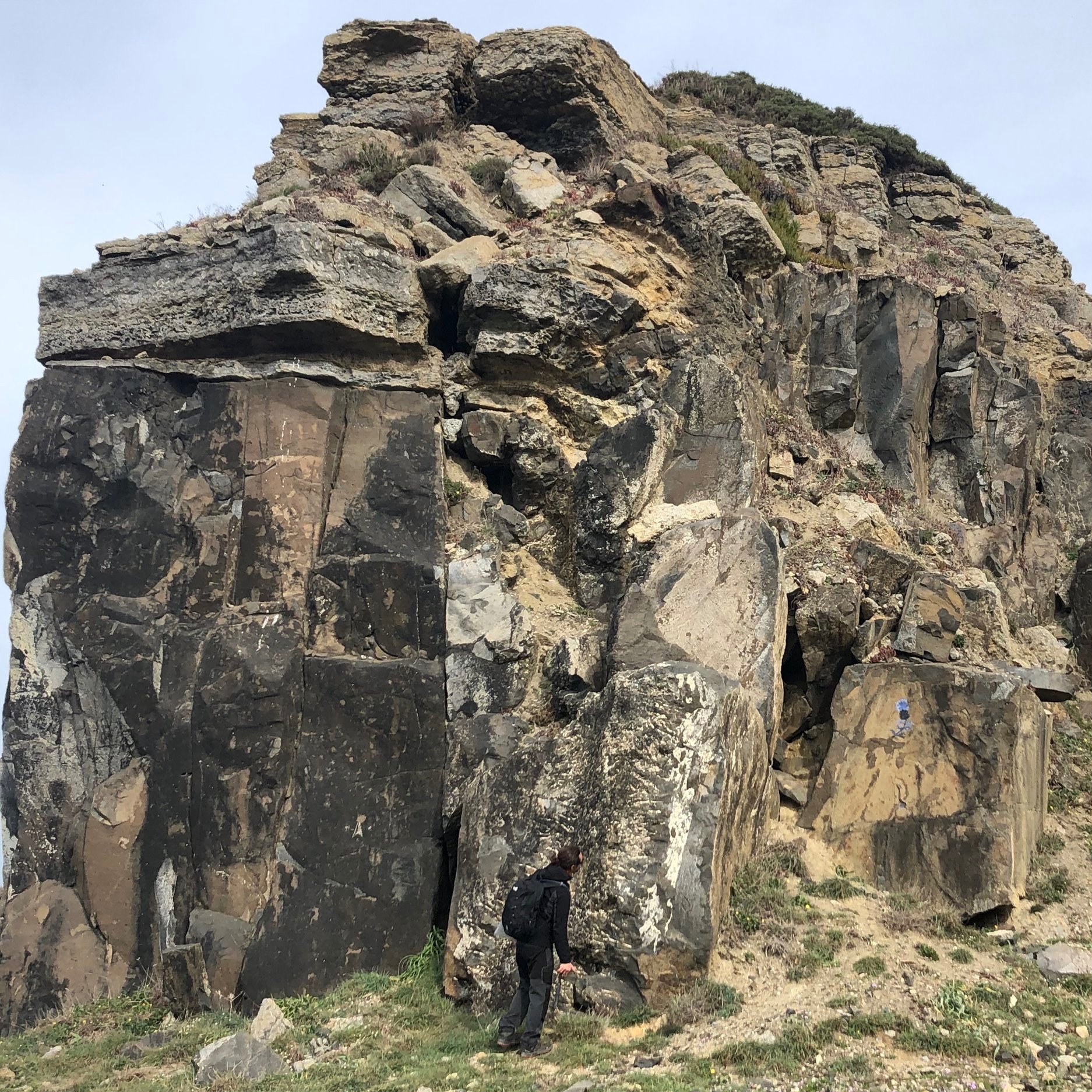
Fault system cutting Cretaceous carbonates and trachybasaltic sill with zeolite-filled decompression fracture network at Lomba dos Pianos.

Volcanic edifice structure and columnar joints types and its implications on carbon storage and carbonation at Penedo do Lexim.

Lisbon Volcanic Complex lava and pyroclastic flows metamorphising Cretaceous rudist limestones. implication on source rock maturation.
Day 5
-
Penedo da Amizade
Sintra Moorish Castle and historical centre
Airport drop off
-
On the last day, the group will observe the geomorphology and landforms associated the erosion of Sintra Igneous Complex at Penedo da Amizade.
To end the field trip participants will have the opportunity to visit Sintra Moorish Castle and historical centre.

Sintra Igneous Complex granites at Palácio da Pena.
References
Barreto, P., Cunha, T., Nuzzo, M., Mata, J., and Pereira, R. 2024. Structural aspects of magmatic rocks: Comparison between outcrop and seismic data interpretation from central Western Iberian Margin (WIM) and relevance for oil and gas, CCS and natural hydrogen. 2024 (conference presentation). AAPG/SEG IMAGE 2024, Houston
Pereira, R., Rosas, F., Mata, J., Represas, P., Escada, C., Silva, B., 2020. Interplay of tectonics and magmatism during post-rift inversion on the central West Iberian Margin (Estremadura Spur). Basin Research, 33, 2 1497- 1519.
Mata, J., Alves, C.F., Martins, L., Miranda, R., Madeira, J., Pimentel, N., Martins, S., Azevedo, M.R., Youbi, N., deMin, A., Almeida, I.M., Bensalah, M.K., Terrinha, P., 2015. 40Ar 39Ar ages and petrogenesis of the West Iberian Margin onshore magmatism at the Jurassic-Cretaceous transition. Lithos, 236-237, 156-172.
Escada, C., Represas, P., Santos, F., Pereira, R., Mata, J., and Rosas, F.M., 2022. New evidence of Late Cretaceous magmatism on the offshore central West Iberian margin (Estremadura Spur) from potential field data. Tectonophysics, v. 832.
Pereira, R., Gamboa, D. 2023: In situ carbon storage potential in a buried volcano (2023). Geology, 51 (9): 803–807.
Rateau R., Schofield, N., and Smith, M. 2013. The potential role of igneous intrusions on hydrocarbon migration, West of Shetland. Petroleum Geoscience. 19. p. 259 - 272.
Kroeger, K., Bischoff, A. & Nicol, A. 2022. Petroleum systems in a buried stratovolcano: Maturation, migration and leakage. Marine and Petroleum Geology, 141.
Gardiner, D., et al., 2019, Modeling petroleum expulsion in sedimentary basins: The importance of igneous intrusion timing and basement composi- tion: Geology, v. 47, p. 904–908
Iyer, K., L. Rupke, and C. Y. Galerne 2013. Modeling fluid flow in sedimentary basins with sill intrusions: Implications for hydrothermal venting and climate change, Geochem. Geophys. Geosyst., 14, 5244– 5262, doi:10.1002/2013GC005012.
Lamur, A., Lavallée, Y., Iddon, F. et al. 2018. Disclosing the temperature of columnar jointing in lavas. Nat Commun 9, 1432 (2018).