

Salt tectonics in central Northern Calcareous Alps (Salzburg Region, Austria)
Salt tectonics in rifts, passive margins and in fold-and-thrust belts. Halokinesis influence on carbonate systems and deformation of layered evaporite sequences.
(On-demand field-based training course)
Introduction
This 4 day field course explores the role of salt tectonics along the Wilson cycle: from rift to passive-margin and from passive margin to orogenesis. We will detail the control of salt tectonics on syn-tectonic carbonate despositional systems, and the feedback sedimentary depocenters exert on the developing salt structures.
The composition of the salt unit is explored at multiple locations, including in the world-famous Hallstatt salt mine. The relationship between heterogeneities in the evaporite unit and tectonic evolution will be discussed, and in turn its impact on the production of salt through dissolution mining.
The aim of the field trip is to provide insights into the development of supra-salt stratigraphy in passive margin and fold-and-thrust belt settings, and on the relevance of structural evolution on the distribution of intra-salt heterogeneities.

Panorama View of Hallein Diapir (valley), Untersberg Triassic extension structure and Jurassic Göll Massif uplift from Sankt Kolomann.
Course Characteristics
Physical requirements: Easy. A basic fitness level is expected (up to 2 km walks without sitting possibilities). Most stops will be within 100-200 m from the drop-off point. One stop requires a 2 km walk on mountain gravel road. One stop requires clambering down/up a 2 m rock embankment. The mine visit will require a 2 km walk inside the mine. Expect climb up/down wooden ladders and uneven terrain in an unlit environment (unsuitable in case of claustrophobia). Expect Alpine weather. This means rain and low temperatures are possible (down to 5°C) and ground may become muddy. The galleries of the Hallstatt mine are at a stable 12°C all year round. Sunny hot days are also possible (up to 25-30°C).
Duration: 4 days
Type: Fieldwork (3.5 days) and in-class (half day intro)
Area: Central Northern Calcareous Alps, Austria
Target audience: Petroleum Geologists, Salt Specialists, PHD students, geologists, field geologists, Petroleum Geologists, CCUS professionals, structural geologists, reservoir geologist and engineers, geology engineers, mining geologists, geothermal geoscientist, geophysicists.
Pre-requisites: Basic geological understanding (e.g., knowing sediment vs evaporite, carbonate vs clastic, rift vs passive margin, structural geology and salt tectonic principles).
What’s included: Transportation, meals, accommodation in 3 star hotels, during the field trip, digital and paper field guide, personal insurance, Geo Logica Safety Kit (Hardcap, reflective vest and walking poles).
Number of participants: Minimum of 6 and maximum 12 persons.
Course Cost: 4500 € (excl. tax). Special discount rates available for EFG - European Federation of Geologists (20%) or APG - Associação Portuguesa de Geólogos members (10%). Early bird discount available (10%) for the first 5 participants until March 2025.

Halokinetic hooks, secondary salt welds and diapir collapse at Hallstatt Echerntal.
Instructors
Oscar Fernandez: PhD from Barcelona University, Oscar is a seasoned structural geologist, with over 20 years of experience and specializing in sedimentary basin analysis. After having held advisorial roles in BP and Repsol, Oscar moved to the University of Vienna in 2019. Besides lecturing in geophysics and geomechanics, he researches the geodynamics of the Eastern Alps and the neighboring mountain chains. He also continues to consult for companies in hydrocarbon exploration and production and in mineral and metal ore exploration. Oscar’s experience ranges across all tectonic settings, from rift and passive margins to accretionary prisms and fold-and-thrust belts, on all continents (except Antarctica!). In many of these environments he has also explored the role of salt in conditioning structural evolution and its control on the development of sedimentary systems, both in the onshore and the offshore.
Pedro Barreto: Founder of Geo Logica, graduated in Geology from University of Lisbon and MSc in Tectonics from Royal Holloway, University of London. Former Senior Structural Geologist at CGG - NPA Satellite Mapping, developed geological mapping for oil, gas and mining exploration in Europe, Africa, Middle East, South America and Asia. Former Senior New Ventures and Exploration Geologist at Partex O&G, was Lead Project Geologist for Portugal and Africa exploration. Co-authored several publications and presentations on rifting and salt-tectonics, and implications on exploration, development and exploitation of natural resources for energy production and storage.
Thomas Leitner: Geologist responsable for the geological operations at Salinen Austria AG, the operator of the Hallstatt mine and other mines in the Austrian Alps.

Field course main instructors Oscar Fernandez (right) and Pedro Barreto (left) standing on evaporitic megabreccia at Rußbach.
Main Topics
- Salt tectonics in rifts, passive margins and in fold-and-thrust belts
- Timing of diapirism and its relation with tectonic events
- Salt diapirism and interaction with sediments: differences and similarities between carbonates and clastic overburden interactions
- Salt tectonics influence on carbonate depositional systems
- Internal structure of diapirs (layered evaporites, volcanic intrusions, interbedded carbonates and clastic sediments, folding, boudinage, faulting and shear zone development in evaporites)
- Fault and salt welds and fluid flow along weld
- Unconformities: J-hook, flap-onlap, low-angle wedges
- Cap rock formation and dissolution breccias around salt structures
- Hydrocarbon trap geometries against salt diapirs
- Structural inheritance and onset of halokinesis
- Salt-sediment interface controlling fluid flow
- Fluid flow through salt
- Reworked breccias from diapiric material and roof sediments
- Roof collapse and sedimentary infill above diapirs
- Implications of field work observations for seismic imaging of salt diapirs and seismic interpretation of salt structures.

Highly folded halite beds deformed around gypsum/ anhydrite breccia blocks/ stringers.
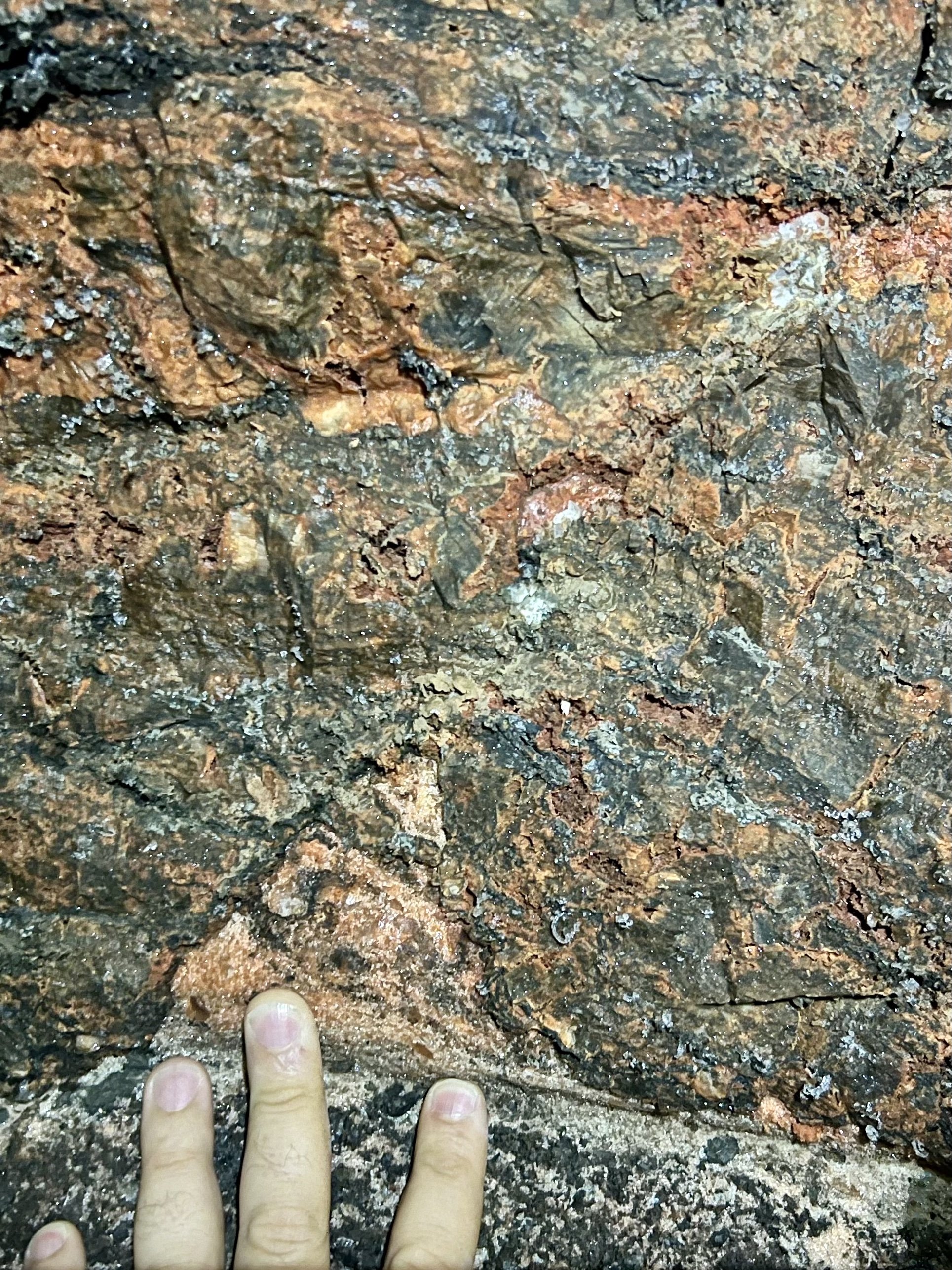
Highly deformed and fractured evaporitic caprock breccia inside Hallstatt Mine.
Course Description
Motivation: The Northern Calcareous Alps provide a unique example worldwide to understand how a salt-rich basin evolved from initial rift and syn-rift evaporite precipitation, through to passive-margin, and finally into inversion and thrusting. Salt tectonics controlled depositional systems throughout, with the early carbonate depositional systems recording different histories in the minibasins and diapir roofs, and with syn-orogenic depositional systems tracking and at the same time conditioning salt-related deformation. The evaporite unit in the Northern Calcareous Alps is Permo-Triassic in age, and equivalent to the Zechstein of northern Europe. Similarities in the deposition and differences in the post-depositional evolution explain the present-day characteristics of the Alpine diapirs.
This area is therefore ideal for those working in structurally complex salt basins, to understand concepts and implications of salt tectonics on hydrocarbon accumulation, energy storage, mining, underground waste management, or CCUS projects in and around salt structures.
Program
Day 0: Overview of the Northern Calcareous Alps: post-Variscan tectonic history, paleogeographic domains (Austroalpine, Neotethys, Alpine Tethys, etc...).
Day 1: Stratigraphy of the Northern Calcareous Alps (Permian evaporites, Triassic carbonates, Jurassic basinal deposits, Cretaceous clastics) and basics of structural configuration (diapirs, minibasins, diapir roofs, Jurassic and Cretaceous shortening and thrusts).
Day 2: Jurassic to Cretaceous thrusting and diapir collapse. Triassic diapirism in Hallstatt.
Day 3: Triassic salt tectonics. Hallstatt mine. Cretaceous thrusting and salt allochthony.
Day 4: Wrap-up on Triassic salt tectonics and Alpine structure with a trip up the Schafberg (seen in The Sound of Music)
Day 0
-
Group gathering at Hotel in Salzburg during the afternoon
Late afternoon kick-off meeting
Icebreaker dinner
Sleep at hotel in Salzburg
-
The group will meet at an hotel (TBD) in Salzburg during the afternoon. The course will start in the late afternoon with a kick-off meeting where the safety briefing will be provided, followed by an introduction to the geology of the Central Northern Calcareous Alps.
The meeting will be followed by icebreaker dinner in Salzburg.

Middle Triassic platform (Wetterstein Dolomite), evaporite sequence (Haselgebirge) and Late Jurassic thrusting at Grundbichler/ Red Bull ski factory.

Calciturbiditic megabreccia at Luegwinkl.
Day 1
-
Depart Salzburg hotel
Arlstein bei Abtenau outcrop
Old Hallstatt Quarry
Grundbichler quarry / Red Bull ski factory.
Lunch at Golling
Luegwinkl Outcrop
Rossfeldstrasse & Lammertal panorama
Return to hotel at Salzburg
Dinner at Salzburg
-
On the first field day the group will depart hotel in Salzburg towards Arlstein bei Abtenau. Here, the group will observe the Lower to Middle Triassic stratigraphy, including the Werfen beds & Gutenstein Fm., while walking approximately 200 m in an old quarry.
Afterwards, at the Old Hallstatt Quarry, participants will observe the Upper Triassic pelagics (Hallstatt Limestone), the Late Jurassic unconformity and first syn-orogenic units.
Just before lunch, at the Grundbichler quarry / Red Bull ski factory, the group will observe the Middle Triassic platform (Wetterstein Dolomite), the evaporite sequence (Haselgebirge) and Late Jurassic thrusting.
After lunch the group will walk about 2km at Luegwinkl to observe the Upper Triassic platform (Dachstein Limestone), the end-rift evolution (Adnet Fm) and the syn-orogenic Upper Jurassic (Strubberg Fm).
The day will end with the spectacular Rossfeldstrasse & Lammertal panorama, where Jurassic thrusting and Cretaceous extension (Lammertal), can be observed as well as the Jurassic uplift (Hoher Göll & Eagle’s Nest), the structure of the Hallein diapir, and Triassic extensional faulting (Untersberg).
Arrival to hotel at Salzburg (Kaiserhof Anif)
Dinner: TBD

Syn-orogenic Upper Jurassic deformation at Sankt Kolomann.

Panorama of the Jurassic Göll Massif uplift from Sankt Kolomann.
Day 2
-
Depart hotel in Salzburg (Kaiserhof Anif)
Panorama at Sankt Kolomann
Trattberg outcrop
Gasthof Bachrain outcrop
Lunch at Golling
Rußbach outcrop.
Gosau panorama
Hallstatt Echerntal
Hotel at Bad Goisern
Dinner at Moserwirt
-
The second day of the course will start at Sankt Kolomann with a Panorama view to understand the structure of the central Northern Calcareous Alps, from Jurassic inversion to Cretaceous thrusting.
Afterwards, at Trattberg, the group will observe Upper Jurassic inversion and cretaceous collapse structures.
In case of poor weather the group will drive to Gasthof Bachrain to observe Rossfeld Fm and allochthonous gypsum.
After lunch in Golling participants will observe the spectacular evaporitic megabreccia at Rußbach outcrop.
This will be followed by a panorama view at Gosau Gasthof Brandwirt, where Gosau Basin and Cretaceous diapir collapse, Upper Jurassic reef will be observed.
The field day will end at Hallstatt Echerntal, where Halokinetic hooks, secondary salt welds, Triassic extension, Hallstatt facies, Jurassic reef and Cretaceous diapir collapse can be observe.
The group will stay at an hotel in Bad Goisern and have dinner in this town.

Jurassic inversion and Cretaceous collapse at Trattberg.

Evaporitic megabreccia at Rußbach outcrop.
Day 3
-
Depart hotel in Bad Goisern
Steegwirt Panorama
Hallstatt Mine
Lunch at Hallstatt
Bad Goisern Panorama
Outcrop at Perneck, Kaiser Leopold Stollen
hotel at Bad Goisern
Dinner at Steegwirt
-
On the third day the group will observe the ramp syncline basin in Dachstein Limestone (Upper Triassic).
Afterwards participants will visit the Hallstatt Mine, which includes a visit to the map room, funicular ride (if available) to the mine and walk around 2 km inside the mine galleries. During this visit the group will observe different lithologies and geological structures in the mine, understand solution mining methods, go inside dissolution cavities and visit the archeological exacavation inside the mine.
After lunch at Hallstatt, participants will do panorama stop at Bad Goisern overlooking Dachstein Cretaceous thrusting.
To end the day, a walk on gravel/paved road near Perneck, Kaiser Leopold Stollen, will take the group to observe the vertical Rossfeld Fm, with Haselgebirge and Wetterstein Dolomite above.
The group will spend another night at the hotel in Bad Goisern. Dinner will take place nearby at Steegwirt.

Hallstatt surface funicular to mine gallery entrance
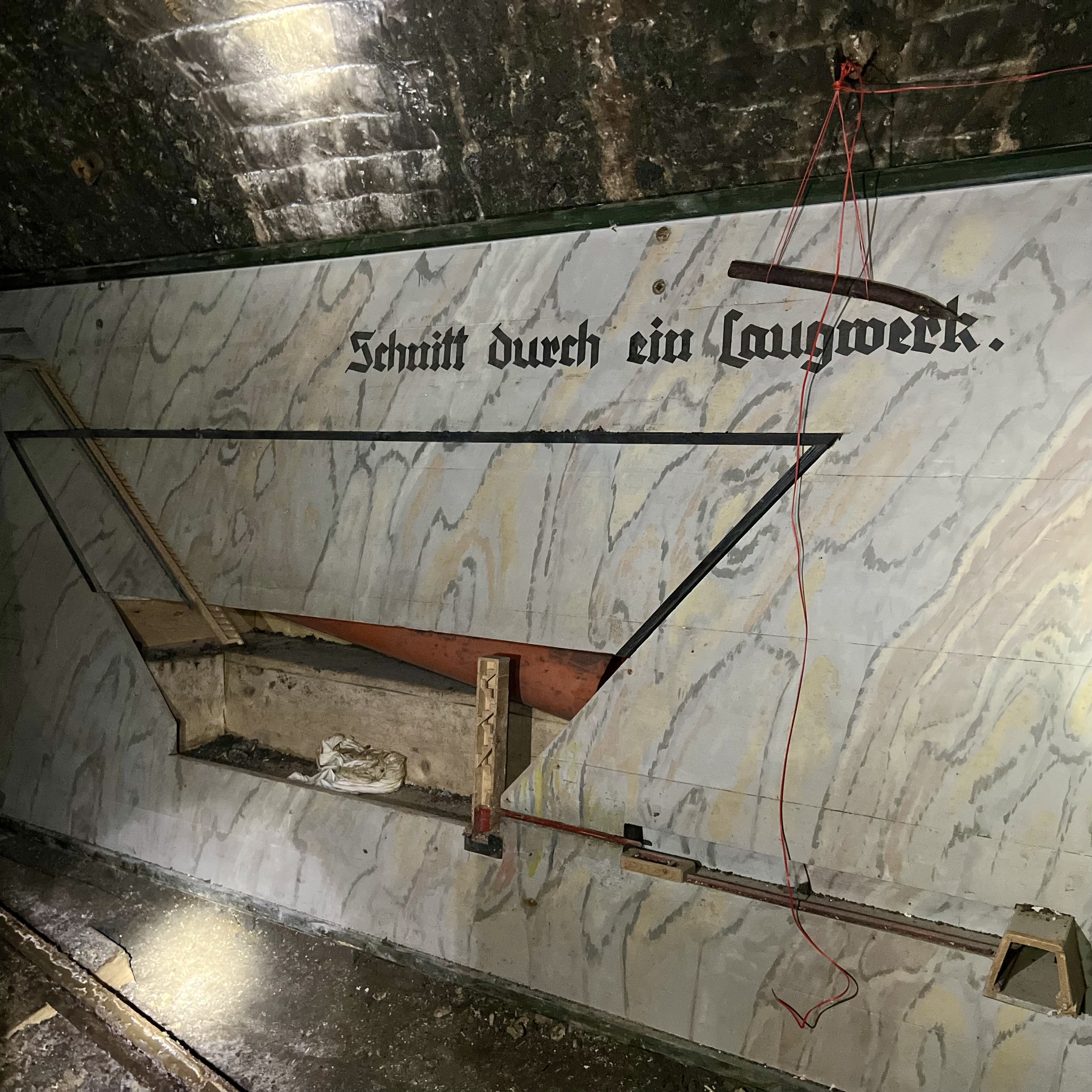
Model illustrating solution mining method used in Hallstatt Salt mine

Intra salt clastic stringers and evaporitic breccia inside Hallstatt mine gallery
Day 4
-
Depart hotel in Bad Goisern
Schafberg (featured in The Sound of Music!):
Return to Salzburg
Arrival to airport at late lunch time
-
On the final day the group will leave hotel in Bad Goisern towards St. Wolfgang.
Here, participants go up the steep railway to Schafberg and enjoy the natural landscapes that featured in The Sound of Music!). From here the group will enjoy the panoramic view while discussing of the geology of Höllengebirge minibasin and Alpine tectonics.
To finish the field trip, the group will drive back to Salzburg with Arrival to airport at late lunch time.

Ramp syncline basin in Dachstein Limestone (Upper Triassic) at Steegwirt.
References
Fernandez et al. (2024). Salt-rich versus salt-poor structural scenarios in the central Northern Calcareous Alps: implications for the Hallstatt facies and early Alpine tectonic evolution (Eastern Alps, Austria). IJES, 113, 245–283. https://doi.org/10.1007/s00531-023-02377-4
Fernandez et al. (2025). Late Jurassic Initial Development of a Salt-Dominated Fold-And-Thrust Belt: The Inverted Passive Margin of the Eastern Alps (Austria). Tectonics, 44, e2024TC008358. https://doi.org/10.1029/2024TC008358
Strauss et al. (2023). The Northern Calcareous Alps revisited: Formation of a hyperextended margin and mantle exhumation in the Northern Calcareous Alps sector of the Neo-Tethys (Eastern Alps, Austria). Earth-Science Reviews, 243, 104488. https://doi.org/10.1016/j.earscirev.2023.104488
Davison, I., Barreto, P. & Andrade, A. (2016). Loulé, the anatomy of a squeezed diapir, Algarve Basin, southern Portugal. Journal of the Geological Society, London, 174, 41–55. https://doi.org/10.1144/jgs2016-035
Davison, I., & Barreto, P., 2020. Deformation and sedimentation processes, and hydrocarbon accumulations on upturned salt diapir flanks in the Lusitanian Basin, Portugal. Petroleum Geoscience, DOI: https://doi.org/10.1144/petgeo2019-138

Panorama view from Steeg peer looking to slump folds in the Dachstein limestones against Triassic age extensional fault.